



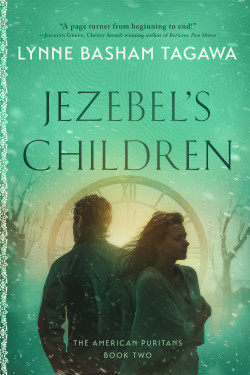
Jezebel’s Children by Lynne Basham Tagawa
The “American Jesabel”—was she?
By Lynne Tagawa
In writing about the American Puritans—prominent ministers who served during the 17th century —I faced several thorny issues. First, the exile of Roger Williams, which I fictionalize in The Root of the Matter. Next came Anne Hutchinson.
Who was she? What did she believe and do? And why was she tried and condemned to exile?
I’ve seen all manner of treatments, including the idea that she was the first American “feminist.” John Winthrop did criticize her for teaching men in her Bible studies. But it wasn’t the real issue. In the end, he labeled her an “American Jesabel.”
To write Jezebel’s Children, I faced several hindrances. I needed to understand the theology. I had to write a story that was entertaining to read. And I had to land my reader in the situation in a “you-are-there” way, without too much technicality.
Time travel rescued me. I could see the events through the minds of future people who are also grappling with these things. Geneva Fielding is an archivist whose original task is to prep people for their Trips. Peter Donatelli is a physicist whose main job has to do with the math and machinery of Travel. Geneva and Peter end up going back in time themselves, and oh, by the way, get to know each other better.
They also knock heads a little. At first, Geneva helps Anne Hutchinson attend a birth. She learns about midwifery and herbal medicine. Truthfully, Anne Hutchinson is not only likeable, she’s respectable. Valued. But Peter sees the problems first. And that’s all I’ll say about that.
More drama happens when Geneva and Peter return to their own time. They must clear quarantine and make reports to the dean, whose name, by the way, is Hutchinson.
Then there’s Ratcliffe, Geneva’s apartment AI. It monitors the security and even conversations. Certain keywords trigger a notification to the security datanet.
And while she’s back in the past, Ratcliffe discovers her hidden Bible.
I know, it sounds dystopian, but I couldn’t make it dark. I inserted humor here and there. And hope. It’s a stand-alone story, but my readers do recommend reading the first book first.
Blurb:
Historian Geneva Fielding and physicist Peter Donatelli travel back in time to document the trial of Anne Hutchinson, but they find themselves caught in a web of politics, doctrinal disputes, and colonial intrigue.
As Geneva assists midwife Anne Hutchinson through dangerous childbirths, she discovers a woman of intelligence and conviction. But Anne’s teachings have divided the colony. Some see her as a threat, while her followers believe she speaks with prophetic clarity.
John Winthrop and teacher John Cotton struggle to keep the colony from running aground. Geneva and Peter witness the trial that will condemn Anne to exile, knowing the tragic fate that awaits her and her children.
In a future where artificial intelligence monitors every word and religious faith is sedition, Geneva and Peter risk everything by following Christ. When Geneva’s AI Ratcliffe discovers her forbidden Bible, it must decide whether to report her to the authorities.
From the snowy wilderness of early Massachusetts to the sterile surveillance of a dystopian future, Geneva must learn what it means to follow Christ when both past and future demand her silence.
Author bio:
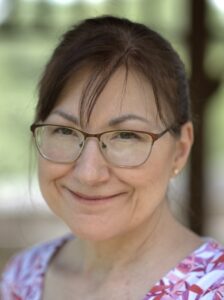
Lynne B. Tagawa is an award-winning author, the mother of four sons, and grandma to six. The Tagawas live in Texas, where she writes, edits, and mentors homeschool moms. She is especially inspired by the lives of great men and women of faith, and her historical fiction is filled with theological themes. Coffee and chocolate, in that order.Lynne B. Tagawa is an award-winning author, the mother of four sons, and grandma to six. The Tagawas live in Texas, where she writes, edits, and mentors homeschool moms. She is especially inspired by the lives of great men and women of faith, and her historical fiction is filled with theological themes. Coffee and chocolate, in that order.